
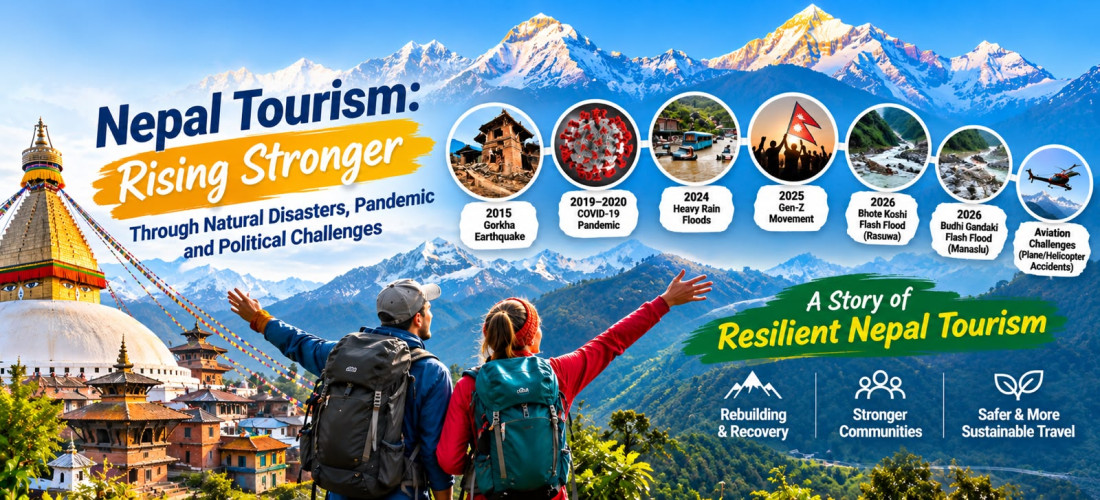
Nepal is a country where the world's highest mountains meet ancient cultures, spiritual traditions and extraordinary natural beauty. From the breathtaking Himalayas and peaceful trekking trails to historic cities, diverse wildlife and welcoming communities, Nepal has long been one of the world's most remarkable travel destinations.
However, behind its beautiful landscapes lies a tourism industry that has repeatedly faced unexpected challenges. Over the last 10–12 years, Nepal has experienced devastating earthquakes, a global pandemic, extreme rainfall and floods, political movements and aviation accidents. Each of these events has affected travel activities, disrupted transportation, impacted local businesses and created uncertainty among international visitors.
Yet, Nepal's tourism story is not simply a story of disasters and setbacks. It is also a story of recovery, determination, adaptation and the strength of the people who depend on tourism for their livelihoods.
From the devastating 2015 Gorkha Earthquake to the COVID-19 pandemic, the September 2024 floods, the Gen-Z movement of 2025 and the flash floods of 2026, Nepal has repeatedly demonstrated its ability to rebuild and welcome visitors again.
The purpose of this article is not to overlook these challenges or minimise their impact. Instead, it is to understand how they have shaped Nepalese tourism, recognise the country's resilience and encourage travellers to continue discovering Nepal responsibly.
Major Challenges Faced by Nepalese Tourism Over the Last 10–12 Years
1. The 2015 Gorkha Earthquake: A Major Turning Point for Nepal Tourism
On 25 April 2015, Nepal experienced one of the most devastating natural disasters in its modern history. The 7.8-magnitude Gorkha Earthquake caused widespread destruction across the country, affecting thousands of families, historic monuments, roads, settlements and infrastructure.
The earthquake also created a major setback for Nepal's tourism industry. Many international travellers postponed or cancelled their trips because of concerns about infrastructure, accommodation, trekking routes and general safety.
International tourist arrivals fell to approximately 538,970 in 2015, a significant decline compared to the previous year.
Historic destinations such as Kathmandu, Bhaktapur and Patan suffered considerable damage to their cultural heritage. Several trekking regions also experienced disruptions, affecting guides, porters, hotels, transport operators and local communities.
However, the earthquake also marked the beginning of a remarkable recovery journey.
Reconstruction projects gradually restored historic landmarks, communities rebuilt their homes and tourism businesses reopened. Trekking routes and accommodation facilities returned to operation as affected areas were assessed and restored.
Nepal demonstrated that although natural disasters can damage infrastructure, they cannot erase the country's cultural identity, natural beauty or determination to move forward.
For travellers today, visiting Nepal also means supporting the communities and businesses that have worked hard to rebuild.
2. COVID-19 Pandemic (2019–2020): When Global Tourism Came to a Standstill
Just when Nepal's tourism industry was making significant progress after the 2015 earthquake, another unprecedented challenge emerged: the COVID-19 pandemic.
The outbreak, which began in late 2019 and developed into a global pandemic in 2020, completely changed the international travel industry.
Nepal's tourism sector was among the industries severely affected by international travel restrictions, border closures, flight suspensions, quarantine requirements and restrictions on trekking and mountaineering activities.
The impact was particularly serious because Nepal depends heavily on international visitors for trekking, mountaineering, adventure tourism, hospitality and cultural experiences.
The country's ambitious Visit Nepal 2020 campaign, which aimed to attract two million international visitors, was also disrupted.
Nepal welcomed approximately 1.19 million international visitors in 2019. This number dropped dramatically to around 230,085 in 2020 and approximately 150,962 in 2021.
Thousands of tourism professionals, including trekking guides, mountain guides, hotel employees, travel operators, drivers and porters, faced financial uncertainty.
However, the pandemic also encouraged Nepal's tourism industry to rethink its approach. Businesses began focusing more on digital marketing, domestic tourism, flexible travel arrangements, hygiene standards and responsible tourism practices.
As international travel restrictions gradually eased, Nepal started welcoming visitors again. Tourist arrivals recovered to more than one million in 2023 and approximately 1.15 million in 2024.
This recovery demonstrated that Nepal remained an attractive destination even after one of the biggest disruptions in modern travel history.
3. September 2024 Heavy Rainfall and Floods: Disrupting Roads and Travel Connections
In September 2024, Nepal experienced extremely heavy rainfall that caused widespread flooding, landslides and transportation disruptions.
Between 27 and 29 September, intense rainfall affected several districts, including Kathmandu, Lalitpur, Bhaktapur, Kavrepalanchok, Dhading, Makwanpur and other parts of the country.
The disaster severely affected daily transportation and travel connections. Several major highways connecting Kathmandu with other tourist destinations were blocked by landslides and damaged infrastructure.
For international visitors, these disruptions created difficulties in reaching trekking destinations, tourist cities and airports. Domestic travellers also experienced delays, cancellations and unexpected changes to their itineraries.
The incident highlighted an important reality about travelling in Nepal: weather conditions, especially during the monsoon season, can influence road accessibility and travel schedules.
Nevertheless, the floods did not diminish Nepal's tourism potential. Once affected routes and infrastructure were assessed and restored, travel activities gradually resumed.
The experience also reinforced the importance of responsible travel planning, checking road conditions, following weather forecasts and maintaining flexible itineraries.
For visitors planning to explore Nepal, understanding seasonal conditions is an essential part of having a safe and enjoyable journey.
4. The Gen-Z Movement of 2025: Political Uncertainty During the Peak Tourism Season
In September 2025, Nepal experienced a significant political and social movement led by young people, commonly known as the Gen-Z movement.
The movement, which gained momentum on 8 and 9 September, was driven by demands for good governance, accountability and action against corruption. The demonstrations escalated into violence, resulting in loss of life, property damage and disruption across different parts of the country.
Unfortunately, the timing created additional difficulties for Nepal's tourism industry.
September marks the beginning of Nepal's major autumn tourism season, when international visitors arrive for trekking, mountaineering, cultural tours and adventure activities.
Political uncertainty, transportation disruptions, security concerns and negative international media coverage affected traveller confidence. Several visitors reconsidered their travel plans, while hotels and travel operators experienced cancellations and booking uncertainty.
The movement also damaged tourism-related infrastructure and businesses, adding further pressure to an industry that had already experienced several major challenges.
However, Nepal's tourism industry responded by focusing on communication, reassurance and recovery. Tourism stakeholders worked to provide updated travel information and encourage visitors to explore destinations where travel conditions were suitable.
The movement also reminded the tourism sector that political stability, public confidence and good governance are important foundations for sustainable tourism development.
Despite these challenges, Nepal continued to attract international travellers, demonstrating that its appeal extends beyond temporary political developments.
5. The 2026 Bhote Koshi and Rasuwa Flash Flood: Another Natural Disaster in the Himalayan Region
In August 2026, another devastating natural disaster affected Nepal's Himalayan region.
On 26 August 2026, a major flash flood struck the Bhote Koshi and surrounding river corridors, particularly affecting Rasuwa and nearby areas. The event was associated with a complex chain of high-altitude geological and hydrological processes, including an ice-and-rock avalanche near the Nepal-China border.
The flood caused significant loss of life, displacement and damage to infrastructure, including roads and river crossings.
The incident raised serious concerns for travel routes connecting northern Nepal, particularly the Rasuwagadhi and Syafrubesi areas.
These regions are important for mountain travel, border connectivity and access to destinations in the Langtang region.
The disaster once again highlighted the vulnerability of Himalayan communities and infrastructure to sudden changes in mountain weather and river conditions.
However, it is important to understand that an incident affecting one river corridor does not automatically mean that every trekking destination in Nepal is inaccessible.
Nepal has a wide range of trekking and tourism destinations across different geographical regions. Langtang, Everest, Annapurna, Manaslu and other regions have different access routes and local conditions. Their accessibility should be checked individually before travelling.
Travellers should always follow current local advisories and avoid entering disaster-affected areas until authorities and local professionals confirm that routes are safe.
6. The October 2026 Budhi Gandaki Flash Flood: Challenges in the Manaslu Region
Another major flash flood event occurred in October 2026 in the Budhi Gandaki river system, affecting areas around the Manaslu region.
According to preliminary assessments, the destructive flood that occurred on 11 October 2026 may have been triggered by the failure of a temporary river blockage created by a landslide near Chumchet in Gorkha district.
The Budhi Gandaki river corridor is an important geographical feature of the Manaslu trekking region. It passes through remote settlements, deep valleys, mountain landscapes and traditional villages that attract trekkers from around the world.
Flash floods in such mountainous environments can damage trails, bridges, local infrastructure and transportation connections.
For the tourism industry, incidents like this create uncertainty for trekking companies, guides, porters, accommodation providers and travellers planning to visit the affected region.
However, the Manaslu region's challenges should not be confused with the condition of all trekking destinations in Nepal.
The most responsible approach is to assess the specific trail, bridges, access roads and local conditions before confirming a trek. Travellers should rely on updated information from local authorities, experienced trekking agencies and regional professionals.
Nepal's mountain destinations remain remarkable places to explore, but responsible travel requires awareness, preparation and respect for changing natural conditions.
7. Plane and Helicopter Accidents: The Importance of Aviation Safety in Mountain Tourism
Nepal's extraordinary geography makes aviation an important part of its tourism infrastructure. Many destinations are located in remote mountain regions where road transportation is limited or unavailable.
Flights to places such as Lukla, Jomsom and other mountain destinations provide essential connections for trekkers, mountaineers, local communities and emergency rescue operations.
Helicopters also play an important role in mountain rescue, medical evacuation, sightseeing and transportation to remote areas.
However, Nepal has experienced several serious aviation accidents involving both fixed-wing aircraft and helicopters. These incidents have raised concerns among international travellers and brought attention to aviation safety in mountainous environments.
Mountain aviation involves several challenging factors, including rapidly changing weather, high-altitude conditions, limited landing infrastructure, difficult terrain and complex flight operations.
Such incidents have continued to keep aviation safety in public discussion and highlighted the importance of stronger safety standards, effective regulation, proper aircraft maintenance, qualified pilots and transparent investigations.
It is important, however, not to judge the entire Nepalese aviation sector through individual accidents. Aviation safety requires continuous improvement and commitment from all stakeholders.
For travellers, choosing reputable airlines and licensed helicopter operators, following weather-related instructions and allowing flexibility in flight schedules are important precautions.
Nepal's mountain flights remain an extraordinary way to experience the Himalayas, but safety must always take priority over convenience or sightseeing opportunities.
Despite Every Challenge, Nepal Tourism Continues to Rise
The past decade has tested Nepal's tourism industry in ways that few destinations have experienced repeatedly within such a short period.
Earthquakes, a global pandemic, extreme weather, political movements and aviation accidents have all affected the confidence of travellers and the livelihoods of tourism professionals.
Yet, one important fact deserves attention: Nepal continues to welcome visitors from around the world.
According to Nepal Tourism Statistics 2025, published by the Government of Nepal, the country received approximately 1,162,365 international tourists in 2025, compared with 1,197,191 in 2019. This indicates that international arrivals have come close to their pre-pandemic level despite the many challenges experienced in between.
These figures reflect more than visitor numbers. They represent the determination of thousands of tourism professionals, hospitality businesses, local communities and entrepreneurs who continue to support Nepal's tourism economy.
From a small teahouse in the mountains to a family-run hotel in Pokhara, from a trekking guide in the Annapurna region to a travel operator in Kathmandu, countless people contribute to keeping Nepal's tourism industry alive.
Their commitment is one of the strongest reasons why Nepal remains a destination worth exploring.
Why Nepal Is Still Worth Visiting Despite These Challenges
1. Extraordinary Natural Beauty That Cannot Be Replaced
Nepal is home to eight of the world's fourteen mountains above 8,000 metres, including Mount Everest.
Its landscapes range from snow-covered Himalayan peaks and alpine valleys to green hills, rivers, forests and subtropical plains.
Every region offers a different experience, making Nepal an incredibly diverse destination for nature lovers, photographers, trekkers and adventure enthusiasts.
2. A Unique Combination of Culture, Heritage and Spirituality
Nepal is not only about mountains. It is also a destination rich in history, religion, architecture and living traditions.
Visitors can explore UNESCO World Heritage Sites in Kathmandu Valley, experience traditional Newari architecture, visit Buddhist monasteries, discover Hindu temples and participate in colourful local festivals.
The country's cultural diversity makes every journey meaningful beyond sightseeing.
3. Warm Hospitality and Resilient Local Communities
One of Nepal's greatest tourism strengths is its people.
Local communities have continued to welcome visitors despite experiencing difficult circumstances. Their hospitality, traditions, food, stories and willingness to share their culture create memorable experiences for travellers.
Tourism also provides livelihoods for guides, porters, drivers, hotel owners, restaurant workers, artisans and countless other professionals.
By choosing Nepal for your next holiday, you contribute directly to these communities and their economic opportunities.
4. A Wide Range of Destinations and Travel Experiences
Nepal offers much more than a single trekking route or mountain destination.
Travellers can choose from different geographical regions and activities depending on their interests, available time and current travel conditions.
Popular travel experiences include Everest Base Camp trekking, Annapurna Circuit trekking, Langtang Valley trekking, Manaslu Circuit trekking, jungle safaris in Chitwan, paragliding in Pokhara, cultural tours in Kathmandu and spiritual journeys to Lumbini.
The diversity of these destinations gives travellers the flexibility to select suitable experiences based on seasonal conditions and local accessibility.
Responsible Tourism: How Travellers Can Support Nepal's Recovery and Growth
Nepal's tourism industry needs more than international attention. It needs responsible travellers who understand the importance of supporting local communities, respecting the environment and making informed travel decisions.
Check Weather and Travel Conditions Before Your Journey
Mountain weather can change rapidly. Before travelling, check official weather forecasts, road conditions, flight updates and trekking route advisories.
Choose Experienced and Registered Trekking Agencies
Working with reputable trekking agencies, qualified guides and licensed transportation providers helps improve the overall travel experience and supports responsible tourism practices.
Travel Beyond Popular Destinations
Exploring different regions of Nepal can help distribute tourism income more evenly. Consider visiting cultural villages, lesser-known destinations and community-based tourism projects when conditions permit.
Respect Local Communities and Natural Environments
Follow local customs, reduce plastic waste, respect wildlife and support businesses that prioritise sustainable tourism.
Stay Flexible With Your Travel Plans
Natural events, road conditions and mountain weather can occasionally change travel schedules. Allowing additional days in your itinerary and maintaining flexible arrangements can help avoid unnecessary stress.
The Future of Nepalese Tourism: From Repeated Setbacks to Sustainable Growth
Nepal's tourism future should not be defined by the disasters it has experienced, but by how effectively the country learns, prepares and grows from them.
The challenges of the last decade have highlighted the need for stronger infrastructure, improved disaster preparedness, reliable transportation, better aviation safety standards, sustainable tourism policies and effective communication with international travellers.
Government institutions, tourism organisations, local communities and private tourism businesses all have an important role to play.
Investment in safer trekking infrastructure, weather monitoring systems, early warning mechanisms, emergency response facilities and responsible mountain tourism can help Nepal become a more prepared and sustainable destination.
At the same time, international travel companies and visitors can contribute by promoting accurate information rather than allowing isolated incidents to define the image of an entire country.
Nepal does not need to pretend that challenges do not exist. Instead, it needs to demonstrate that it recognises those challenges and is continuously working towards better preparedness and recovery.
The mountains remain magnificent, the culture remains alive, the trails continue to offer unforgettable experiences and the people continue to welcome visitors.
Nepal Is More Than Its Challenges: Come and Experience Its Beauty
Over the last 10–12 years, Nepal has experienced several events that have tested its tourism industry. From the 2015 earthquake and COVID-19 pandemic to devastating floods, political movements and aviation incidents, each challenge has left its mark.
But Nepal's identity is much bigger than these difficult moments.
It is the sunrise over the Himalayas, the peaceful trails of the Annapurna region, the spiritual atmosphere of ancient temples, the wildlife of Chitwan, the beauty of Pokhara and the warmth of its people.
Every responsible traveller who visits Nepal becomes part of a larger story of recovery, opportunity and sustainable development.
At Amazing Nepal Trek, we believe that travelling is not just about reaching a destination. It is about discovering cultures, connecting with people and experiencing the natural world responsibly.
We encourage travellers to explore Nepal with proper planning, updated travel information and experienced local professionals.
Nepal is still here, its mountains are still calling, and its people are ready to welcome you.
Come to Nepal. Discover its beauty. Support its people. Be part of its journey forward.
Frequently Asked Questions (FAQs) About Nepal Tourism
1. Is Nepal safe to visit despite frequent natural disasters?
Yes, Nepal remains a popular international travel destination. However, safety conditions vary by region and season. Travellers should check current weather forecasts, road conditions, trekking advisories and official travel updates before departure.
2. Has Nepal's tourism industry recovered from the 2015 earthquake?
Yes. Nepal's tourism industry gradually recovered through infrastructure reconstruction, heritage restoration and the reopening of tourism businesses. International tourist arrivals reached approximately 1.19 million in 2019, showing substantial recovery after the earthquake.
3. How did COVID-19 affect tourism in Nepal?
COVID-19 severely affected Nepal's tourism industry through international travel restrictions, flight suspensions and border closures. Tourist arrivals dropped dramatically in 2020 and 2021, but the industry gradually recovered as international travel resumed.
4. Is trekking in Nepal possible after the 2026 floods?
Trekking remains possible in Nepal, but accessibility depends on individual destinations and current conditions. Some areas affected by the 2026 floods may require trail repairs, infrastructure assessments or temporary restrictions. Always consult local authorities and experienced trekking agencies before departure.
5. What is the best time to visit Nepal for trekking?
The spring season (March–May) and autumn season (September–November) are generally considered the best periods for trekking in Nepal because of favourable weather and mountain visibility. However, actual conditions vary by region and year.
6. Which trekking destinations can travellers explore in Nepal?
Popular trekking destinations include Everest Base Camp, Annapurna Circuit, Annapurna Base Camp, Langtang Valley, Manaslu Circuit and Upper Mustang. Travellers should check the latest accessibility and permit requirements before choosing a route.
7. Do political movements in Nepal affect international tourists?
Political movements can occasionally affect transportation, business operations and travel schedules. However, their impact is not necessarily nationwide or permanent. Visitors should monitor reliable updates and follow local guidance.
8. Is Nepal suitable for first-time international travellers?
Absolutely. Nepal offers cultural tours, wildlife experiences, mountain adventures, city sightseeing and guided trekking opportunities for different experience levels. First-time visitors can enjoy a comfortable journey by choosing suitable itineraries and reliable local travel operators.
9. How can tourists support Nepal's local communities?
Tourists can support local communities by hiring local guides and porters, staying in locally owned hotels, purchasing local products, visiting community-based tourism destinations and respecting local traditions.
10. Why should travellers choose Nepal despite its past challenges?
Nepal offers extraordinary natural landscapes, diverse cultures, adventure opportunities and warm hospitality. Its tourism industry has repeatedly demonstrated resilience, and responsible travel helps create employment and economic opportunities for local communities.




 (1) (1).jpg)


